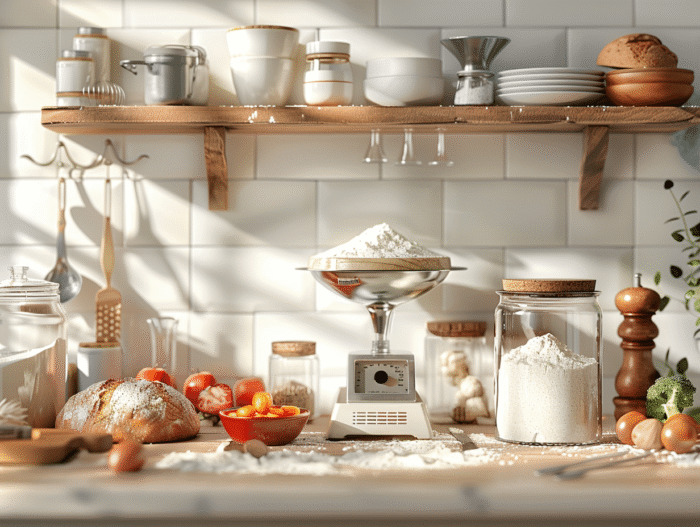
In cooking, precision is often the key to a successful dish, especially when it comes to baking or complex recipes. For amateur cooks as well as seasoned chefs, mastering the art of measuring ingredients can make the difference between a delectable dish and a culinary disaster. From standard measuring cups and spoons to electronic scales, there are a multitude of methods and tools to accurately quantify the components of a recipe. Some tips can help measure without specialized tools, using everyday objects to achieve equally reliable results.
The Fundamentals of Ingredient Measurement
In the field of professional catering, culinary precision relies on a deep understanding of units of measurement in cooking. These units, whether expressed in volume or weight, form the basis of any culinary preparation. The process of converting measurements is thus essential when one wishes to adjust the portions of a recipe or adapt ingredients available in various forms. For example, measuring ‘250 grams of flour in a glass’: without proper measuring tools, this precise quantity seems difficult to achieve. Yet, it is essential to ensure the desired outcome.
The categories of liquid, dry ingredients, and weight require specific measuring tools. Spoons and cups are preferred for small quantities, while scales are necessary for larger measurements. These tools are even more indispensable when it comes to respecting the proportions dictated by a recipe, where every gram can influence the texture or flavor of the final dish. Indeed, the relationships between the units of measurement used to quantify ingredients and the tools needed to perform these measurements are intrinsic to the success of a dish.
In light of these requirements, the conversion chart becomes a valuable ally. It allows for flexibility in recipe preparation, making it easier for cooks who must juggle different units of measurement. This chart serves as an accessible reference, enabling easy conversion between volumes and weights and vice versa. Whether adapting a recipe for a larger number of guests or substituting one ingredient for another, the conversion chart provides the ability to adjust quantities with confidence and agility.
Techniques and Tips for Measuring Without a Scale
The mastery of measurement techniques without a scale is an asset for cooks who find themselves, by choice or circumstance, without this tool. Using everyday utensils then presents itself as a practical and clever alternative. The tablespoon, universally found in our kitchens, proves to be a surprising measuring instrument: it is equivalent to 15 ml, facilitating the measurement of liquids or powdered ingredients with notable precision.
In this same vein, the mustard glass, an iconic object in our homes, can transform into an auxiliary gauge. It is often used to measure volumes such as that of a cup of flour or sugar, allowing one to follow a recipe without a scale. As for the yogurt pot, it serves as a significant measuring standard for bulk ingredients. These containers, due to their standardized size, offer a method of measurement by substitution, suited to the demands and creativity of home cooking.
Skill and intuition in cooking also play a crucial role in measuring ingredients without a scale. Culinary know-how allows one to gauge, with a certain ease, the necessary quantities for preparing a dish. Indeed, the experience gained over time allows for an accurate understanding of the consistency and volume of ingredients, even in the absence of formal measuring tools. Cultivate this expertise, as it provides valuable freedom of action and flexibility in the art of gastronomy.