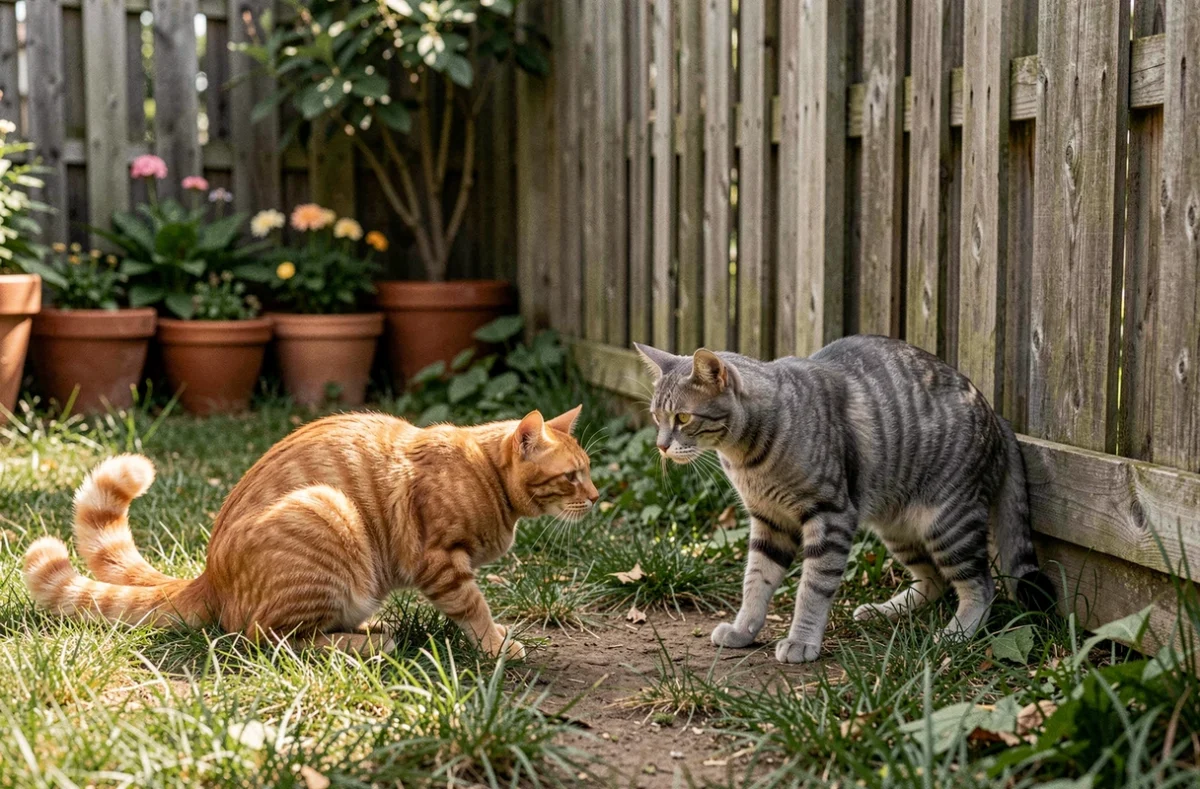
One morning, you spot an unknown cat settled on your terrace, just a few meters away from your own feline who is watching it, tense. This situation is common and often generates concern. Understanding what drives a strange cat to venture into another’s territory allows you to react without escalating tensions between the two animals.
Pheromones and markings: the invisible language between neighboring cats
Even before they physically cross paths, two cats communicate through scents. A feline leaves pheromones by rubbing its head against door frames, garden furniture, or fences. These chemical signals indicate its presence, health status, and reproductive status.
A visiting cat does not just appear randomly. It has first “read” the scent markings left by your cat. If your pet frequently urinates at the edges of the garden, it is precisely to convey this message: “occupied zone.” The problem is that pheromones attract as much as they repel. An unneutered cat, for example, will be stimulated by hormonal signals and will actively seek to get closer.
Scratching on trees or posts serves a similar role. It leaves both a visual mark and an olfactory deposit between the pads. A foreign cat that spots these marks knows that a fellow feline lives there, but it may still take its chances, especially if food or shelter resources are attractive.
To fully understand why a cat comes onto my cat’s territory, it is important to consider that feline territory is not a fixed block but a set of overlapping areas of interest between neighbors.
Visiting cat: identifying if it is lost, stray, or a neighbor’s
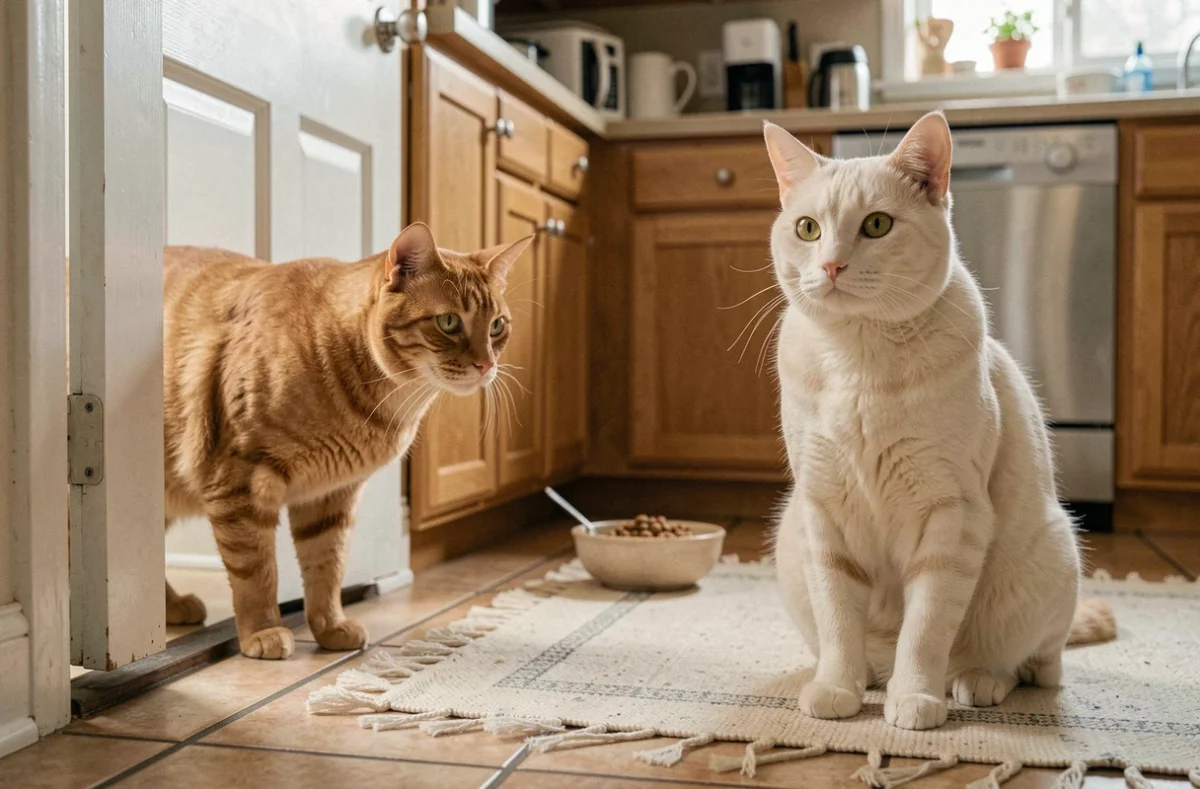
Not all cats that cross your fence are in the same situation. Before making a decision, it is necessary to distinguish three scenarios.
- The neighbor’s cat, identified and fed, which is simply expanding its walking perimeter. It returns regularly at the same times, appears healthy, and shows no signs of distress.
- The lost cat, often disoriented, that meows a lot, seems thin, or has a dull coat. Having its microchip scanned by a veterinarian is the first reflex to locate its owner.
- The stray or “free” cat, which lives outdoors without a known owner. In France, the town hall must organize the care of found stray cats and usually has a pound, either directly or through an agreement.
Some municipalities allow the capture, sterilization, and return of cats living in groups in a public place. A cat roaming near you may therefore belong to a colony monitored by a local association. Checking for the existence of such a program prevents unnecessary intervention.
Territorial behavior of the cat in the face of an intruder: decoding the signals
Your cat has spotted the visitor long before you did. Several behaviors indicate its discomfort or active defense.
A cat that stares out a window for long minutes is watching an intruder spotted outside. This vigilance may seem innocuous, but it generates chronic stress if the situation repeats daily. The feline remains alert, sleeps less, and may develop behavioral issues.
Hissing and growling are the next phase. Your cat fluffs up its fur, arches its back, and emits low sounds to intimidate the other without fighting. In most cases, this posture is enough to make a less motivated cat back off.
However, if the visitor persists, fights may break out. These sometimes result in bites or abscesses that require a veterinary visit. An unneutered cat fights more frequently to defend its territory.
Unusual indoor urine marking
When a cat senses an external threat, it reinforces its markings inside the house. Urine sprays on walls, door frames, or curtains are not a cleanliness issue. It is a direct response to the perceived intrusion. The indoor environment must then be secured so that the feline regains a sense of control over its space.

Tips for reducing intrusions from a strange cat into your garden
Keeping a visiting cat away without harming your own animal requires some concrete adjustments.
Blocking visual access immediately reduces your cat’s stress. An opaque film on the lower part of a window or a privacy screen along the fence eliminates the constant visual confrontation. Your feline stops keeping watch and returns to a normal resting rhythm.
Calming pheromone diffusers, plugged into the rooms where your cat spends the most time, help it feel safe despite the presence of an intruder outside. These are not repellents against the visitor but support your pet’s well-being.
- Bring in food bowls after each meal. An accessible bowl systematically attracts neighborhood cats.
- Avoid leaving open shelters (shed, garage) that offer a resting point for the visitor.
- Install a motion detector coupled with a water spray in the garden. The device surprises the foreign cat without physical contact.
- Sterilize your own cat if it hasn’t been done yet. A sterilized animal emits fewer attractive hormonal signals and fights less.
When feeding by a neighbor complicates the situation
If a neighbor regularly feeds neighborhood cats, it can attract more felines to your home. Feeding is not automatically illegal, but it can become a source of neighborhood conflict when it leads to repeated nuisances. Since decree n° 2023-695 of July 29, 2023, health regulations govern these practices. A conversation with the concerned neighbor, or even a report to the town hall, remains the most effective approach before any escalation.
The presence of a strange cat on your feline’s territory rarely stems from deliberate aggressive behavior. It is most often a matter of resources, scents, and overlapping living areas. Identifying the visitor’s status, securing your cat’s indoor environment, and limiting external attraction sources resolve the vast majority of situations without harsh intervention.