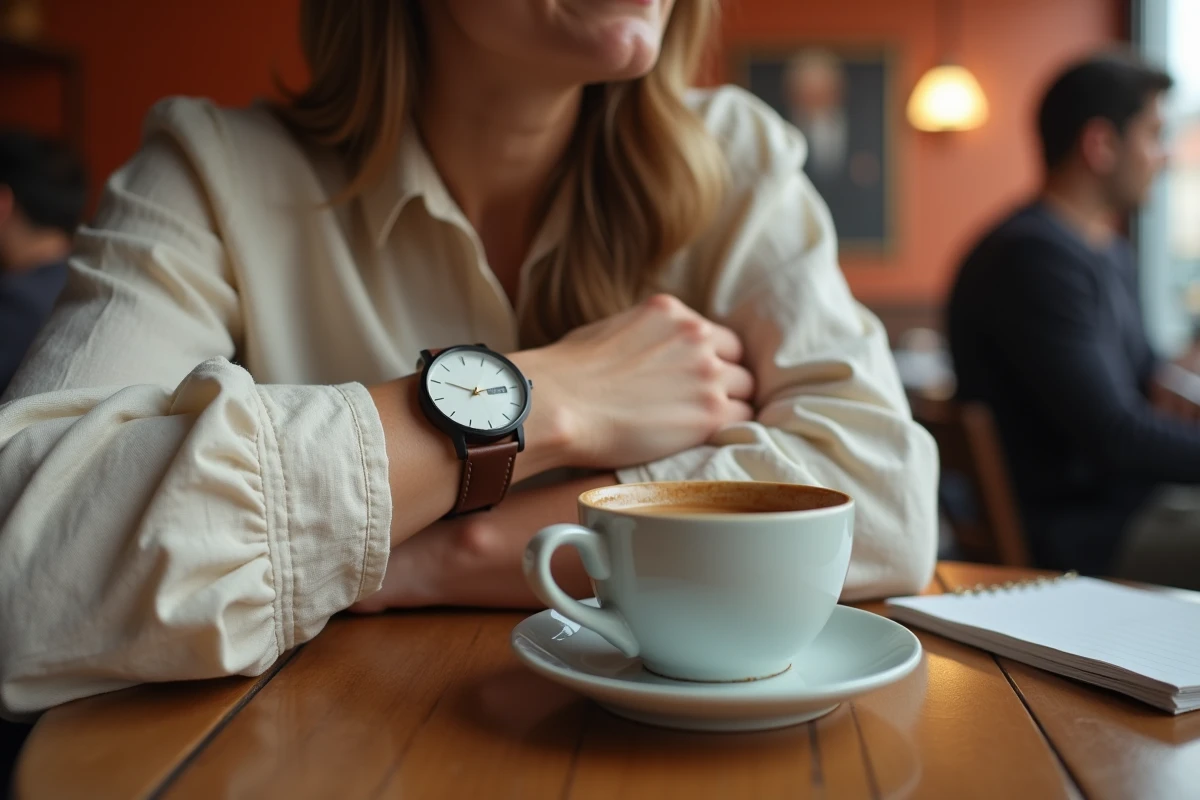
Wearing your watch with the dial facing inward on the wrist breaks with the usual convention. This gesture, far from being trivial, responds to specific logics that vary according to profession, social context, or even the type of watch used. The reverse wearing of the dial has existed for decades in certain professional environments, and its use now extends well beyond that.
Upside-down watches and smartwatches: an overlooked practical use
With the widespread adoption of smartwatches, many users intentionally turn their watch around for purely functional reasons. Smartwatches worn with the dial facing inward avoid a recurring problem: accidental touch screen activations.
On touchscreen models, the dial facing outward on the wrist activates at the slightest contact. An unintentional tap on a surface, a rub against a bag, or a movement in the gym is enough to trigger an unwanted command. Turning the watch around eliminates this issue.
The protection of the screen also comes into play. Facing the skin, the glass is less exposed to daily shocks and scratches. For those who engage in contact sports or work with their hands, this orientation prolongs the device’s lifespan. Exploring the meaning of wearing a watch upside down allows us to gauge how this gesture goes beyond mere technical reflex.

Lateralization and wrist ergonomics: beyond the military cliché
The explanation based on profession (soldier, caregiver, diver) dominates most content. It masks a more fundamental factor: the lateralization and fine motor skills of each person directly influence the choice of dial orientation.
A left-handed person wearing their watch on their right wrist does not have the same natural reading angle as a right-handed person. The active wrist (the one of the dominant hand) performs frequent rotations. Orienting the dial inward then offers a quicker reading without needing to turn the forearm.
Micro-joint discomfort and daily comfort
The crown, located on the side of the case, can press against the back of the hand during certain wrist flexions. This discomfort, imperceptible to some, becomes a recurring annoyance for others. Turning the dial moves the crown inward on the arm, eliminating the pressure point.
Thus, it is not a symbolic choice in this case, but a personal ergonomic adaptation. The morphology of the wrist, the thickness of the case, and daily activities weigh as much as tradition or style in this decision.
Discretion and politeness: the hidden dial as a social code
Checking the time in the middle of a conversation or meeting is still perceived as a sign of impatience. The classic gesture (turning the wrist toward oneself, arm raised) draws the attention of the interlocutor. Wearing the dial inward allows for a quick glance at the time, without any visible movement.
In contemporary watchmaking discourse, this discretion is increasingly associated with a form of refinement. The idea that true luxury is not flaunted is gaining traction in collector circles and in professional environments where image matters. Hiding the dial signals that one owns a watch without showing it, which reverses the usual ostentatious logic.
A different signal depending on the professional context
The meaning of this gesture varies according to the environment:
- In medical or military contexts, the turned dial facilitates quick reading during pulse checks or tactical synchronizations, without a light reflection that could betray a position
- In corporate settings, it expresses a desire not to ostentatiously display a valuable piece, especially in front of interlocutors whose relationship with money is unknown
- In informal social contexts, it may simply reflect a habit inherited from a parent or mentor, without conscious intention

Wearing an upside-down watch and personal identity: what style reveals
Beyond function, the choice of dial orientation contributes to the construction of a distinctive personal style. In a world where the watch remains one of the few socially accepted male accessories, every detail of wearing sends a message.
Some public figures have popularized this habit, turning it into a recognizable visual marker. The gesture then becomes an element of identity just like the choice of strap or brand. It fits into a broader logic where dress codes serve as a non-verbal language.
Current fashion values deviations from conventions. Wearing a watch upside down, like wearing a ring on an unusual finger or layering chains of different styles, is part of the same movement: asserting a personal choice against established social norms.
Neither trend nor whim
Reducing this gesture to a passing trend would be a mistake. Online testimonials show that the majority of those concerned cite comfort or practicality first, well before style. The symbolic meaning, when it exists, is constructed afterward, through the accumulation of a habit that has become second nature.
Wearing a watch upside down encapsulates ergonomic, social, and aesthetic concerns in a single gesture. Whether the dial is turned to avoid a reflection during operations, protect a touchscreen, or simply read the time without raising the arm, the reason may differ, but the choice remains firmly rooted in a concrete logic.